
Nanlite FC-60B 60W Bi-Color Led COB Light - Lab Test
- Marvin Kuhn
- Lab report , Lights
- 23 January 2026
Table of Contents
Nanlite FC-60B – Technical Analysis
The Nanlite FC-60B is a compact 60 W bi-colour COB light with a range from 2700K to 6500K, aimed at mobile creators, interviews and corporate work. Measurements were taken at a distance of 1 m without modifiers, plus one measurement with the standard reflector, across a total of 9 individual measurements (linear mode).
| Score | Value |
|---|---|
| Total | 83.1 |
| Colour | 78.0 |
| Power | 98.5 |
| Usability | 72.8 |
Scores and lab report based on the current version of our evaluation (October 2026). The power score refers to the output with the standard reflector (16,909 lux).
🔍 Key Measurements (White Light, 100%, 1 m)
| Parameter | 2700K | 3200K | 5500K | 6500K |
|---|---|---|---|---|
| Brightness (Lux) | 2,406 | 2,868 | 3,067 | 2,880 |
| CRI (Ra) | 97.2 | 95.5 | 96.6 | 97.3 |
| R9 (Red Rendering) | 89 | 91 | 93 | 95 |
| TM-30 Rf/Rg | 96/101 | 95/104 | 94/103 | 94/101 |
| SSI | 88 | 80 | 72 | 69 |
| CCT Deviation (MK-1) | 6.14 | 13.46 | 4.80 | 5.57 |
| DUV | -0.0003 | -0.0060 | -0.0025 | +0.0011 |
🔎 Performance Analysis
💡 Light Output
Unmodified, the FC-60B reaches up to 3,067 lux at 5500K at a distance of 1 m (EV 10.3). Between 3200K and 6500K, output stays within about 7% (2,868 to 3,067 lux). Only 2700K drops off more noticeably with 2,406 lux, around 22% below the peak. That is typical for bi-colour engines, where the warmest setting runs on a single LED channel.
With the standard reflector, the light reaches 16,909 lux at 5500K (EV 12.7). That is about 5.5 times the bare output and the basis for the strong power score of 98.5. For a light of this size, that is a very good result.
Dimming is clean and almost perfectly linear:
| Setting | 3200K | 5500K |
|---|---|---|
| 10% | 307 lx (10.7%) · 3,235 K | 313 lx (10.2%) · 5,718 K |
| 50% | 1,458 lx (50.8%) · 3,311 K | 1,546 lx (50.4%) · 5,643 K |
| 100% | 2,868 lx · 3,344 K | 3,067 lx · 5,649 K |
Exposure can therefore be controlled precisely and reproducibly via the percentage display. The only catch is the colour temperature at 3200K, which shifts with brightness (see CCT accuracy).
Standout Features:
- ✅ Strong output with reflector: 16,909 lux at 5500K, power score 98.5
- ✅ Very linear dimming: 10% power ≈ 10–11% light, 50% ≈ 50–51%
- ⚠️ Weaker at 2700K: 2,406 lux, around 22% below the 5500K peak
🎨 Colour Rendering (White Light)
Colour rendering is very good for this power class. CRI (Ra) sits between 95.5 and 97.3 across all colour temperatures, and R9 ranges from 89 at 2700K to 95 at 6500K. Skin tones and saturated reds therefore stay clean throughout. TLCI (for information) reaches 97 to 99.
TM-30 Rf lies between 94 and 96, with Rg between 101 and 104. At 3200K, Rg 104 points to slightly increased saturation, which usually looks lively rather than unnatural in practice.
The SSI is highest at the warm end with 88 at 2700K and still a solid 80 at 3200K. Towards daylight, it drops to 72 at 5500K and 69 at 6500K. That is the typical behaviour of conventional bi-colour engines and matters mainly when matching the FC-60B with high-quality daylight sources.
Standout Features:
- ✅ High colour fidelity: Ra 95.5–97.3, R9 89–95
- ✅ Very good SSI at warm CCTs: 88 at 2700K, 80 at 3200K
- ⚠️ SSI drops towards daylight: 72 at 5500K, 69 at 6500K
🧪 TM-30 in Detail
TM-30 divides colours into 16 hue bins. The local chroma shift (Rcs) shows whether a hue is rendered more or less saturated than under the reference light, the local fidelity (Rf,h) how accurately it is rendered overall. Shifts of a few percent are barely visible; from around 10%, the affected hues look noticeably more intense or duller.
| CCT | Largest chroma shift (Rcs) | Lowest local fidelity (Rf,h) | Weakest sample | CES below 90 |
|---|---|---|---|---|
| 2700K | max. +3%, almost neutral | 92 (red-purple, bin 16) | CES 91: Rf 85 | 6 of 99 |
| 3200K | +5% blue and violet (bins 12/14) | 91 (red-purple, bin 16) | CES 91: Rf 77 | 8 of 99 |
| 5500K | +10% purple (bin 15) | 88 (cyan-blue and purple, bins 11/15) | CES 91: Rf 73 | 14 of 99 |
| 6500K | +11% violet (bin 14) | 85 (cyan-blue, bin 11) | CES 91: Rf 68 | 19 of 99 |
2700K is the cleanest setting: all 16 hue bins stay within ±3%, local fidelity never drops below 92, and only 6 of the 99 colour samples fall below Rf 90. At 3200K, blue and violet are slightly emphasised, which matches the Rg of 104.
At 5500K and 6500K, the FC-60B shows the typical daylight pattern of phosphor-converted LEDs: purple and violet are rendered around 10% more saturated, while fidelity drops to 85–88 in the cyan-blue range. Blue-green to cyan-blue tones also show a small hue shift (up to 0.08). In practice, this affects purple fabrics, flowers and turquoise product colours most; they can look somewhat more intense or slightly off compared with reality.
Skin tones sit mainly in the orange-red and orange bins (2 and 3). There, the FC-60B stays within ±1% saturation and reaches Rf,h 96 to 98 at every colour temperature, so faces remain natural even in the weaker daylight settings.
The spectrum peaks at 633–634 nm in the warm settings and at 449–450 nm (blue pump) in the daylight settings.
Standout Features:
- ✅ Very neutral at 2700K: all hue bins within ±3%, Rf,h ≥ 92
- ✅ Skin tones stable: bins 2/3 at Rf,h 96–98 across all CCTs
- ⚠️ Daylight pattern: purple/violet +10–11%, cyan-blue Rf,h down to 85
🌡️ CCT Accuracy
The deviation in Mired (MK-1) is more meaningful than the raw Kelvin difference, since the Kelvin scale is not linear:
| Target CCT | Measured | Deviation | MK-1 | Duv |
|---|---|---|---|---|
| 2700 K | 2,656 K | -44 K | 6.14 | -0.00025 |
| 3200 K | 3,344 K | +144 K | 13.46 | -0.00602 |
| 5500 K | 5,649 K | +149 K | 4.80 | -0.00252 |
| 6500 K | 6,744 K | +244 K | 5.57 | +0.00106 |
At 2700K, 5500K and 6500K, the deviation stays well below the threshold of around 10 MK-1 at which a shift becomes perceptible. 3200K is the outlier: at 3,344 K and 13.46 MK-1, it looks visibly cooler than set when matched exactly against tungsten sources.
3200K also shifts with brightness. At 10%, the FC-60B measures 3,235 K, at 100% 3,344 K. That corresponds to a drift of around 10 MK-1 within the same setting. At 5500K, the light stays much more stable (5,718 K at 10%, 5,649 K at 100%, around 2 MK-1).
Standout Features:
- ✅ Precise at 2700K, 5500K and 6500K: 4.80–6.14 MK-1
- ⚠️ 3200K too cool: 3,344 K, 13.46 MK-1
- ⚠️ CCT drift at 3200K across dimming levels: around 10 MK-1 between 10% and 100%
✅ Strengths
- Very good colour fidelity for this power class → Ra above 95 at every CCT, R9 between 89 and 95, TM-30 Rf 94–96
- Strong output with the standard reflector → 16,909 lux at 5500K, power score 98.5
- Clean, linear dimming → 10% power ≈ 10–11% light, no visible jumps
- Very clean warm white → SSI 88 at 2700K, all TM-30 hue bins within ±3%
- Natural skin tones → Orange and orange-red bins at Rf,h 96–98 at every CCT
- Compact and mobile → Well suited for location work and small setups
⚠️ Weaknesses
- Limited daylight performance → SSI 72 at 5500K and 69 at 6500K, purple/violet oversaturated by 10–11%, cyan-blue Rf,h down to 85
- CCT accuracy at 3200K → 3,344 K instead of 3,200 K (13.46 MK-1), plus a drift of around 10 MK-1 between 10% and 100%
- Slight magenta tint at 3200K → Duv -0.0060 at 50% and 100%, -0.0066 at 10%
- Lower output at 2700K → Around 22% less light than at 5500K
📉 Practical Applications
Ideal for: → Interviews and podcasts: natural skin tones, linear dimming → YouTube, social and corporate content: high colour fidelity in a compact form factor → Warm, cosy looks at 2700K: the cleanest setting of this light → Mobile photo and video jobs: strong output with reflector for the size
Use with caution: → High-end cinema productions: daylight SSI below premium level → Mixed lighting with a strong daylight component: SSI 69–72 makes matching more demanding → Products in purple, violet or turquoise: visible saturation and fidelity deviations at daylight CCTs → Exact tungsten matching at 3200K: visibly cooler than set
📌 Conclusion
The Nanlite FC-60B is a compact, honest bi-colour COB light with very good colour rendering, clean dimming and a strong output with the standard reflector. It is clearly aimed at mobile creators, content producers and corporate applications where portability matters more than maximum output or cinematic spectral values.
The detailed analysis shows where its strengths and weaknesses lie: 2700K is remarkably neutral, and skin tones stay natural at every colour temperature. 3200K measures noticeably too cool and also shifts with brightness, and at daylight CCTs, purple and violet become more saturated while cyan-blue loses fidelity. Anyone looking for a light, reliable light with good colour fidelity who can live without absolute CCT precision at 3200K gets a very solid solution below the professional cinema class with the FC-60B.
Data Overview
TM-30-18
TM-30 Multi Report
TM-30 Comparison
Multiple measurements in direct comparison
Report selection by CCT
All loaded reports are sorted by CCT automatically. The slider snaps to the nearest report.
Color Vector Graphic
Reference and test as closed 16-bin curves.
Normalized Spectral Power Distribution
TM-30 Dashboard
Local shifts and radial visualization as in the standard report.
Local Chroma Shift (Rcs,hj)
Local Hue Shift (Rhs,hj)
Local Color Fidelity (Rf,hj)
Color Sample Fidelity (Rf,CESi)
Direct overview of all 99 CES samples with fidelity values.
Measure Comparisons
Additional comparison view analogous to the TM-30 reference representation.
Color Evaluation Samples
Highlighted skin-tone areas provide practical orientation for portrait colors. Click to zoom.
Chart
Related Articles
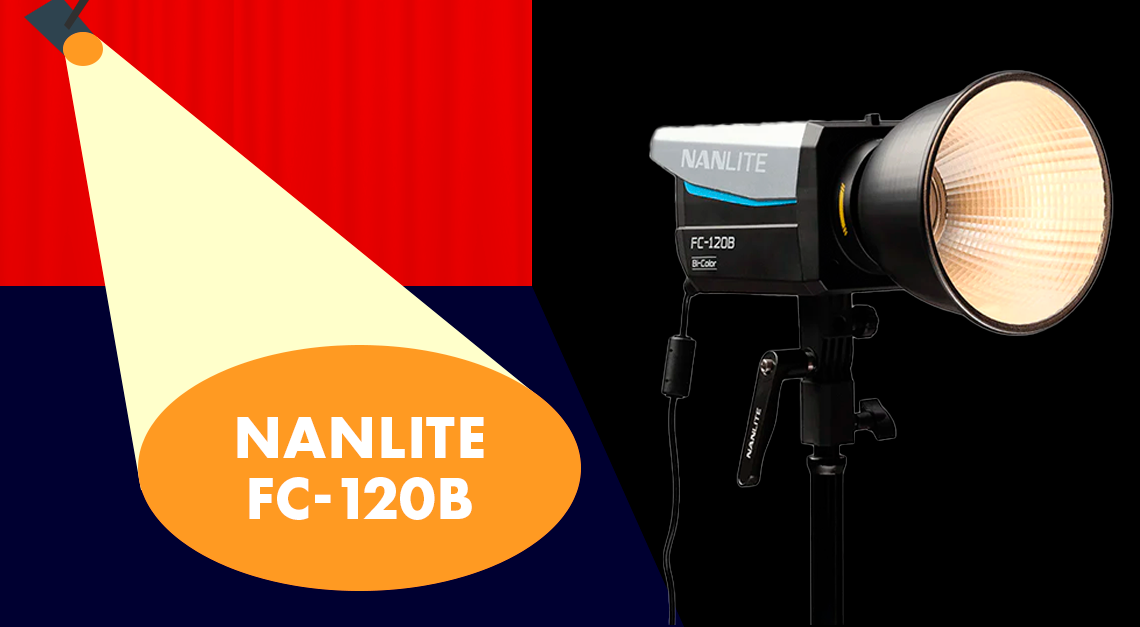
Posts about the bigger brother Nanlite FC-120B:

Nanlite FC-60B

Nanlite FC-60B
Product Features
- Energieversorgung: Netzbetrieb, Akkubetrieb
- Lichtstärke: 60 W
- Farbtemperatur Bereich: 2700 - 6500 K
- Leistung pro Leuchtmittel: 60 W
- Lieferumfang: FC-60B, Netzteil und Kabel, Reflektor, Bowens Adapter, Tragekoffer
Copyright © of product image in the title image are the ones of the respective manufacturers. All rights reserved.


