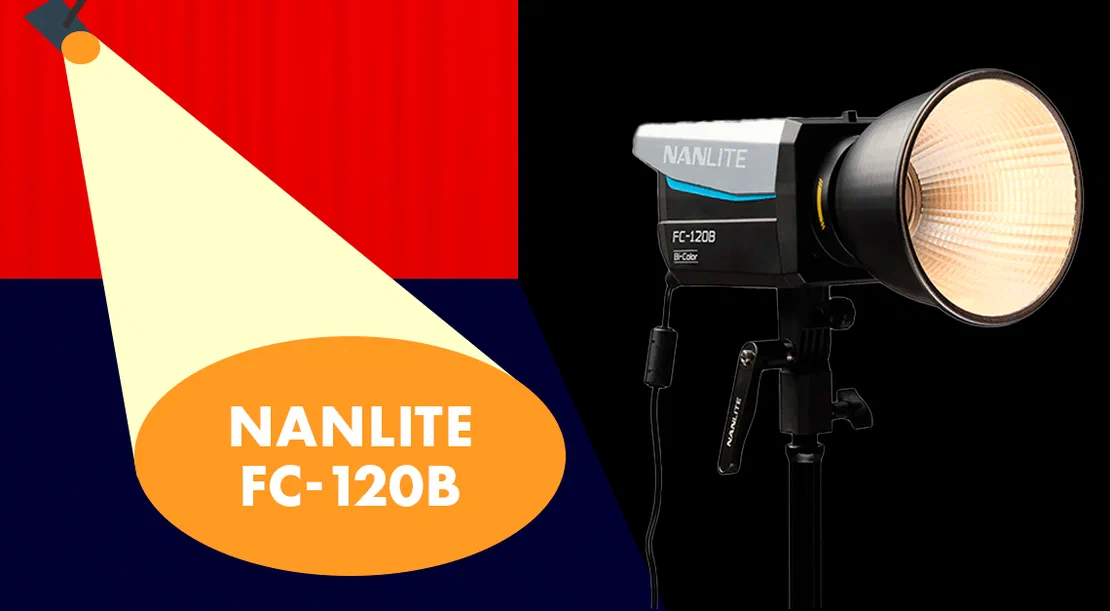
Nanlite FC-120B 120W Bi-Color Led COB Light- Lab-Review
- Marvin Kuhn
- Lab report , Lights
- 24 April 2025
Table of Contents
Nanlite FC-120B – Technical Analysis
The Nanlite FC-120B is a 120 W bi-colour COB light with a range from 2700K to 6500K and two operating modes, Normal and Max. Measurements were taken at a distance of 1 m without modifiers, plus one measurement with the standard reflector, across 9 individual measurements per mode. Our rating is based on Normal mode.
| Score | Normal (rating) | Max |
|---|---|---|
| Total | 79.7 | 78.7 |
| Colour | 75.6 | 75.5 |
| Power | 91.9 | 89.0 |
| Usability | 71.7 | 71.7 |
Our rating is based on Normal mode; Max mode is listed for reference only. Scores and lab reports based on the current version of our evaluation (October 2026). The power score refers to the output with the standard reflector (22,576 lux in Normal mode).
🔍 Key Measurements (White Light, 100%, 1 m, Normal Mode)
| Parameter | 2700K | 3200K | 5500K | 6500K |
|---|---|---|---|---|
| Brightness (Lux) | 4,301 | 4,360 | 4,343 | 4,229 |
| CRI (Ra) | 96.7 | 95.7 | 97.2 | 97.0 |
| R9 (Red Rendering) | 89 | 95 | 94 | 90 |
| TM-30 Rf/Rg | 95/100 | 95/103 | 94/102 | 93/100 |
| SSI | 88 | 80 | 72 | 69 |
| CCT Deviation (MK-1) | 10.14 | 18.47 | 4.61 | 8.92 |
| DUV | +0.0004 | -0.0047 | -0.0017 | +0.0021 |
🔎 Performance Analysis
💡 Light Output
In Normal mode, the FC-120B delivers around 4,300 lux at a distance of 1 m (EV 10.7 to 10.8). Its standout feature is consistency: between 2700K and 6500K, output varies by only about 3% (4,229 to 4,360 lux). Unlike most bi-colour lights, it does not lose noticeable output at the warm end, which makes it very easy to plan with in multi-light setups.
With the standard reflector, the light reaches 22,576 lux at 5500K (EV 13.1), about 5.2 times the bare output. That is the basis for the power score of 91.9.
Dimming is close to linear, with a slightly lifted low end:
| Setting | 3200K | 5500K |
|---|---|---|
| 10% | 488 lx (11.2%) · 3,281 K | 478 lx (11.0%) · 5,800 K |
| 50% | 2,245 lx (51.5%) · 3,361 K | 2,241 lx (51.6%) · 5,663 K |
| 100% | 4,360 lx · 3,401 K | 4,343 lx · 5,643 K |
At 3200K, however, the colour temperature shifts noticeably with brightness: from 3,281 K at 10% to 3,401 K at 100%, a drift of almost 11 MK-1. At 5500K, the change stays at about 5 MK-1.
Standout Features:
- ✅ Exceptionally even output across CCTs: about 3% spread in Normal mode
- ✅ Strong output with reflector: 22,576 lux at 5500K
- ✅ Near-linear dimming: 10% power ≈ 11% light
- ⚠️ CCT drift at 3200K: almost 11 MK-1 between 10% and 100%
🎨 Colour Rendering (White Light)
CRI (Ra) sits between 95.7 and 97.2 across all colour temperatures. R9 ranges from 89 at 2700K to 95 at 3200K. At 10%, R9 drops slightly to 87 to 88. TLCI (for information) reaches 97 to 99.
TM-30 Rf lies between 93 and 95, with Rg between 100 and 103, so colours look natural to slightly saturated.
The SSI is 88 at 2700K, 80 at 3200K, 72 at 5500K and 69 at 6500K. This is the typical pattern of a conventional bi-colour engine: very good at the warm end, moderate in daylight.
Standout Features:
- ✅ High colour fidelity: Ra 95.7–97.2, R9 89–95
- ✅ Very good SSI at 2700K: 88
- ⚠️ SSI drops towards daylight: 72 at 5500K, 69 at 6500K
🧪 TM-30 in Detail
TM-30 divides colours into 16 hue bins. The local chroma shift (Rcs) shows whether a hue is rendered more or less saturated than under the reference light, the local fidelity (Rf,h) how accurately it is rendered overall. Shifts of a few percent are barely visible; from around 10%, the affected hues look noticeably more intense or duller.
| CCT | Largest chroma shift (Rcs) | Lowest local fidelity (Rf,h) | Weakest sample | CES below 90 |
|---|---|---|---|---|
| 2700K | ±3% max., almost neutral | 92 (blue, blue-violet and red-purple) | CES 91: Rf 83 | 8 of 99 |
| 3200K | +5% blue (bin 12) | 92 (blue and red-purple, bins 12/16) | CES 91: Rf 76 | 10 of 99 |
| 5500K | +9% purple (bin 15) | 87 (purple, bin 15) | CES 91: Rf 72 | 15 of 99 |
| 6500K | +11% violet (bin 14) | 86 (cyan-blue and violet, bins 11/14) | CES 91: Rf 67 | 21 of 99 |
2700K is very clean: all hue bins stay within ±3%, local fidelity never drops below 92, and only 8 of the 99 colour samples fall below Rf 90. At 3200K, blue and violet are slightly emphasised (+4 to +5%), which matches the Rg of 103.
At 5500K and 6500K, the typical daylight pattern of phosphor-converted LEDs appears: purple (+9%) and violet (+11%) become more saturated, while fidelity in cyan-blue and purple/violet drops to 86–88. Cyan-blue tones also show a small hue shift (up to 0.08). At 6500K, 21 colour samples fall below Rf 90.
Skin tones in the orange-red and orange bins (2 and 3) are rendered very consistently: at every colour temperature, they reach Rf,h 96 to 98 with saturation shifts of at most ±1%.
The spectrum peaks at 632–633 nm in the warm settings and at 449–451 nm (blue pump) in the daylight settings.
Standout Features:
- ✅ Very neutral at 2700K: all hue bins within ±3%, Rf,h ≥ 92
- ✅ Skin tones very stable: bins 2/3 at Rf,h 96–98 across all CCTs
- ⚠️ Daylight pattern: purple/violet +9–11%, Rf,h down to 86
🌡️ CCT Accuracy
The deviation in Mired (MK-1) is more meaningful than the raw Kelvin difference, since the Kelvin scale is not linear:
| Target CCT | Measured | Deviation | MK-1 | Duv |
|---|---|---|---|---|
| 2700 K | 2,776 K | +76 K | 10.14 | +0.00038 |
| 3200 K | 3,401 K | +201 K | 18.47 | -0.00473 |
| 5500 K | 5,643 K | +143 K | 4.61 | -0.00174 |
| 6500 K | 6,900 K | +400 K | 8.92 | +0.00207 |
5500K is precise at 4.61 MK-1, and 6500K stays just below the threshold of around 10 MK-1 at which a shift becomes perceptible. 2700K is right at the threshold with 10.14 MK-1.
3200K is the clear outlier: at 3,401 K and 18.47 MK-1, it is visibly cooler than set. In addition, Duv of -0.0047 (-0.0058 at 10%) shows a slight magenta tendency, and the CCT drifts by almost 11 MK-1 across the dimming range. If you need to match tungsten sources exactly, you will have to correct this setting, for example by setting the light a little warmer.
Standout Features:
- ✅ Precise at 5500K: 4.61 MK-1, Duv -0.0017
- ⚠️ 3200K too cool: 3,401 K, 18.47 MK-1, plus a slight magenta tendency
- ⚠️ 2700K at the threshold: 10.14 MK-1
⚡ Normal vs. Max Mode
In Max mode, the FC-120B delivers more light between 3200K and 6500K, but loses its standout consistency:
| Parameter | Normal | Max |
|---|---|---|
| 2700K (Lux) | 4,301 | 4,076 (-5%) |
| 3200K (Lux) | 4,360 | 4,762 (+9%) |
| 5500K (Lux) | 4,343 | 5,354 (+23%) |
| 6500K (Lux) | 4,229 | 4,982 (+18%) |
| 5500K with standard reflector (Lux) | 22,576 | 26,308 (+17%) |
| Output spread 2700K–6500K | about 3% | about 31% |
| SSI (2700/3200/5500/6500K) | 88/80/72/69 | 88/80/73/69 |
| MK-1 at 3200K | 18.47 | 17.51 |
At 2700K, Max mode even measured slightly less light than Normal mode. Colour rendering, TM-30 and CCT accuracy are practically identical in both modes; the daylight pattern in purple and violet and the cool 3200K setting remain in Max mode as well.
Max mode is therefore useful when a single light at 5500K or 6500K needs every last lux. Since stable output across colour temperatures matters more in multi-light setups than a few extra lux, our rating is based on Normal mode.
Strengths and weaknesses
Strengths
- Exceptionally even outputAbout 3% spread between 2700K and 6500K in Normal mode
- High colour fidelityRa 95.7–97.2, R9 89–95, TM-30 Rf 93–95
- Very clean warm whiteSSI 88 and all TM-30 hue bins within ±3% at 2700K
- Stable skin tonesBins 2/3 at Rf,h 96–98 at every CCT
- Strong output with reflector22,576 lux in Normal mode, 26,308 lux in Max mode
Weaknesses
- 3200K clearly too cool3,401 K (18.47 MK-1), plus a drift of almost 11 MK-1 across the dimming range
- Slight magenta tendency at 3200KDuv -0.0047, -0.0058 at 10%
- Limited daylight spectrumSSI 72 and 69, purple/violet oversaturated, Rf,h down to 86
- Max mode inconsistentOutput spread of about 31% across CCTs
📉 Practical Applications
Ideal for: → Corporate and commercial production: consistent output, high colour fidelity → Studio interviews and podcasts: stable skin tones, predictable dimming → Multi-light setups with mixed CCTs: almost identical output at every colour temperature → Warm looks at 2700K: the cleanest setting of this light
Use with caution: → Exact tungsten matching at 3200K: visibly cooler than set → Mixed lighting with daylight: SSI 69–72 → Products in purple, violet or turquoise: visible deviations at daylight CCTs
📌 Conclusion
The Nanlite FC-120B is a reliable light for corporate, studio and commercial production. Its biggest strength is consistency: in Normal mode, it delivers almost the same output at every colour temperature, combined with high CRI/R9 values and very stable skin tones.
The detailed analysis shows where its limits lie: 3200K measures clearly too cool and also shifts with brightness, and daylight settings show the usual oversaturation in purple and violet. Max mode adds output at 5500K and 6500K, but gives up consistency. Anyone who can live with a correction at 3200K gets a solid, predictable tool for everyday professional work.
Data Overview
Normal mode (basis of our rating)
Max mode (for reference)
TM-30-18
TM-30 Multi Report
TM-30 Comparison
Multiple Measurements in Direct Comparison
Report selection by CCT
All loaded reports are sorted by CCT automatically. The slider snaps to the nearest report.
Color Vector Graphic
Reference and test as closed 16-bin curves.
Normalized Spectral Power Distribution
TM-30 Dashboard
Local shifts and radial visualization as in the standard report.
Local Chroma Shift (Rcs,hj)
Local Hue Shift (Rhs,hj)
Local Color Fidelity (Rf,hj)
Color Sample Fidelity (Rf,CESi)
Direct overview of all 99 CES samples with fidelity values.
Measure Comparisons
Additional comparison view analogous to the TM-30 reference representation.
Color Evaluation Samples
Highlighted skin-tone areas provide practical orientation for portrait colors. Click to zoom.
Chart
Related Articles
Diclaimer
This product was provided free of charge by Dedotec. However, this has no influence on my opinion or the evaluation of the product. I tested the light independently and shared my honest opinion. The product went back to the provider after the test.

Nanlite FC-120B

Nanlite FC-120B
Product Features
- Energieversorgung: Netzbetrieb, Akkubetrieb
- Lichtstärke: 145 W
- Farbtemperatur Bereich: 2700 - 6500 K
- Leistung pro Leuchtmittel: 145 W
- Lieferumfang: FC-120B, Netzteil und Kabel, Reflektor, Bowens Adapter, Tragekoffer
Copyright © of product image in the title image are the ones of the respective manufacturers. All rights reserved.


