
Nanlux Evoke 150C Review & Lab Test: 150W RGB LED Light
- Marvin Kuhn
- Review , Lab report , Lights
- August 12, 2026
Table of Contents
The Nanlux Evoke 150C does not simply promise 150 watts of RGB output. From the very first use, it quickly becomes clear that Nanlux did not primarily design this light for small creator setups. The Evoke 150C feels much more like a tool for professional film sets, studios and rental houses. Even so, the light is also interesting for creators and smaller productions.
There are now quite a few 150-watt RGB lights on the market. So the more interesting question is: What does the Evoke 150C do better than a conventional RGB COB light and can you actually notice the difference in practical use? I used the Evoke 150C both on set and under controlled conditions in the lab.
Build Quality and Handling
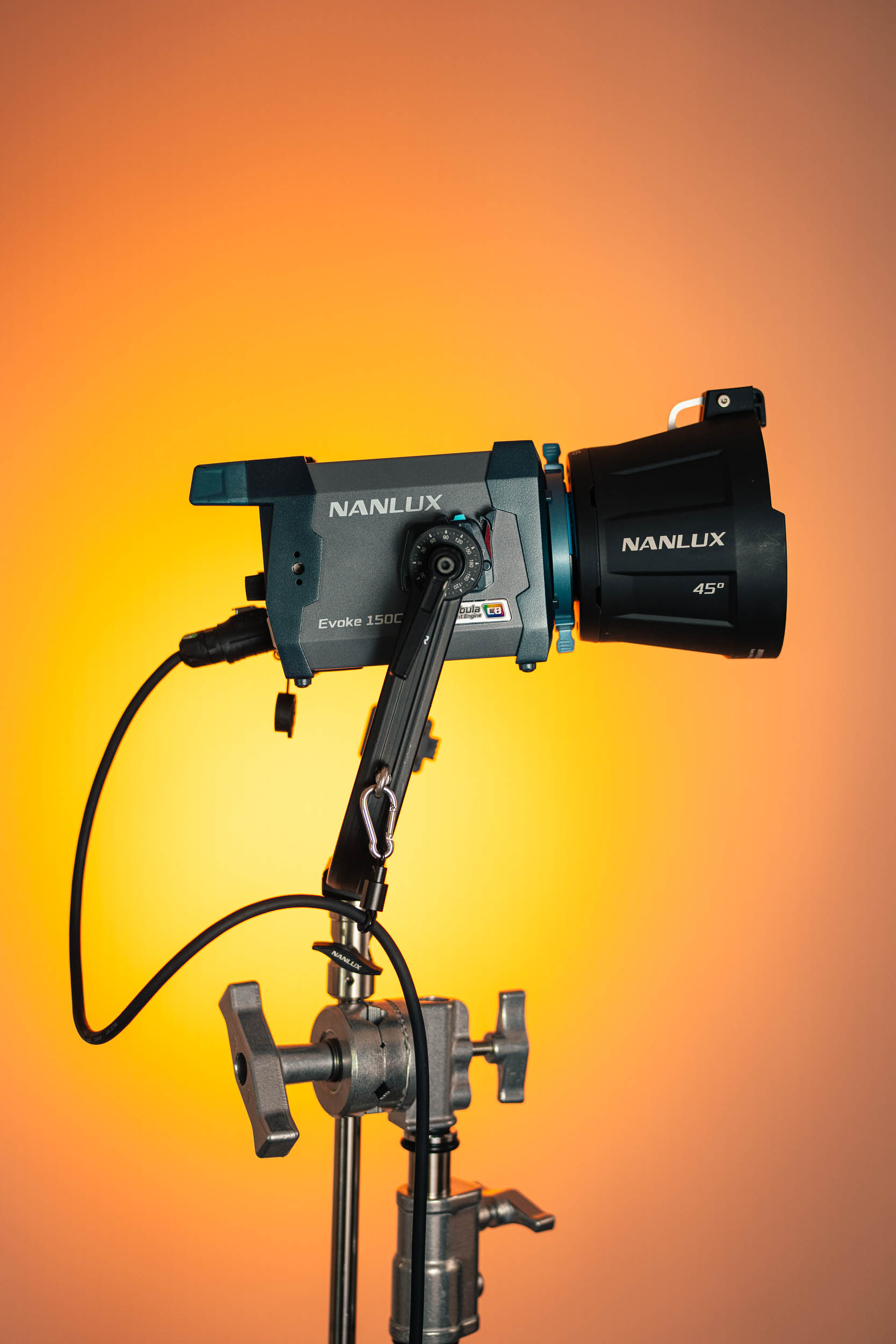
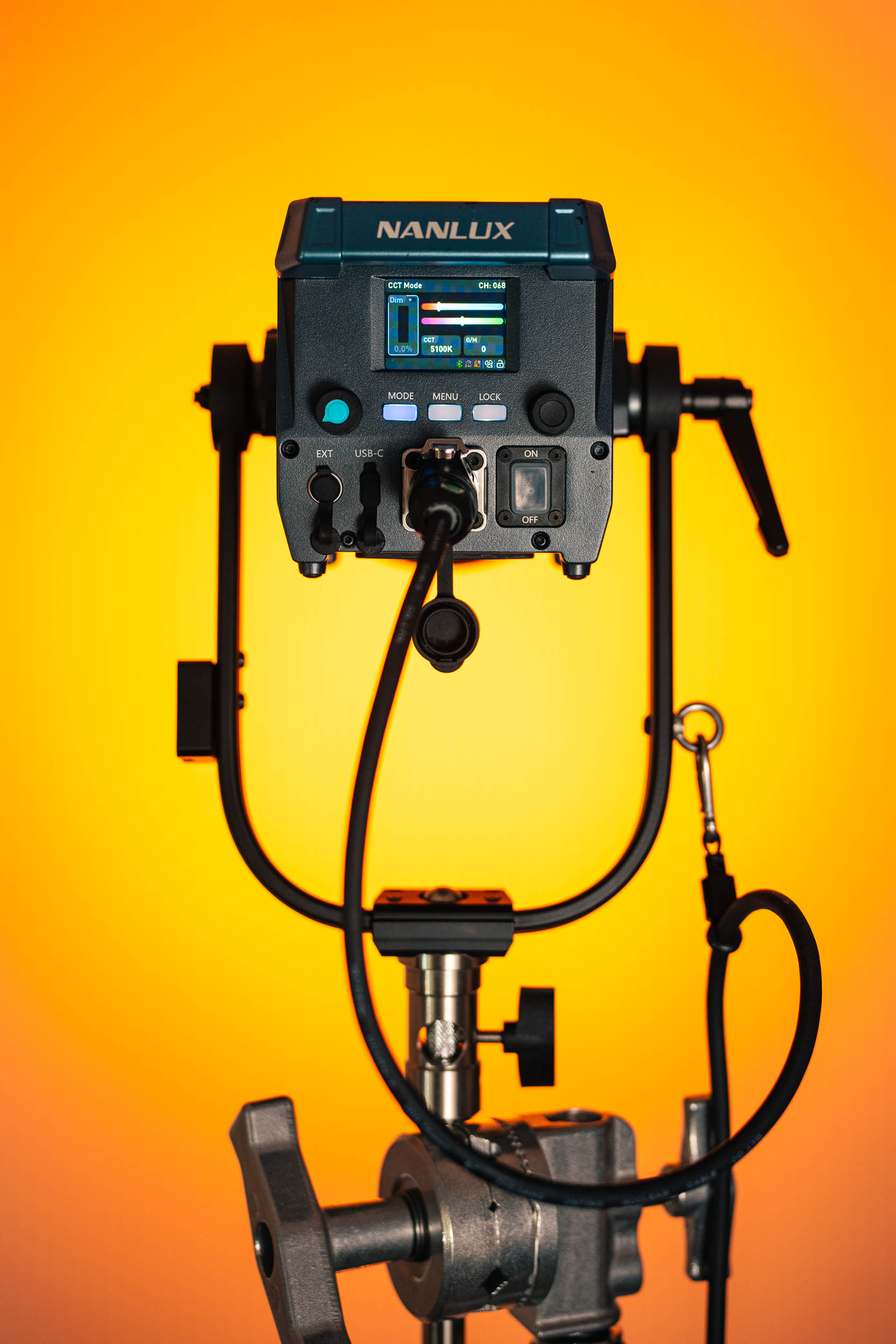
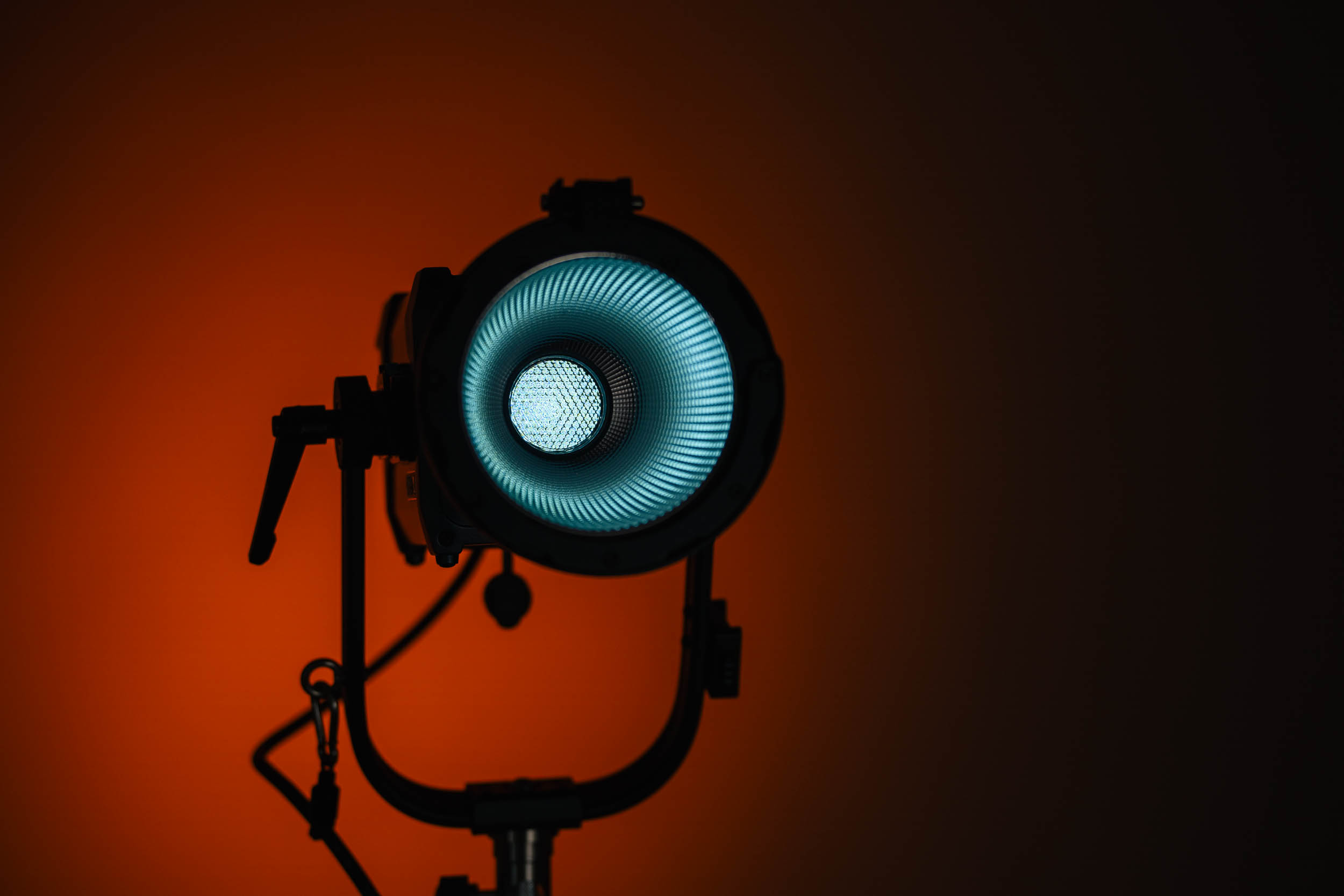
One of the first things I noticed about the Evoke 150C was its build quality. The light feels extremely robust. Nothing feels unnecessarily fragile or cheap and the connectors and controls give much more of an impression of professional production equipment than a typical creator light.
The IP66 rating fits perfectly with this approach. If a light is regularly transported, rented out or used outdoors, this is an advantage that should not be underestimated. For me, the Evoke 150C is therefore one of those lights where you quickly realise what kind of environment it was designed for: film sets, studios, rental houses and professional productions.
The same professional approach is also apparent in the power connection. Nanlux uses a locking power connector, which prevents the cable from simply being pulled out of the fixture by accident. Especially when light stands are being moved, cables are running across the floor or fixtures are mounted in unusual positions, this type of connection is much more reassuring than a simple power plug. It is one of those details that may not look particularly exciting on a specification sheet but makes a real difference in practical use.
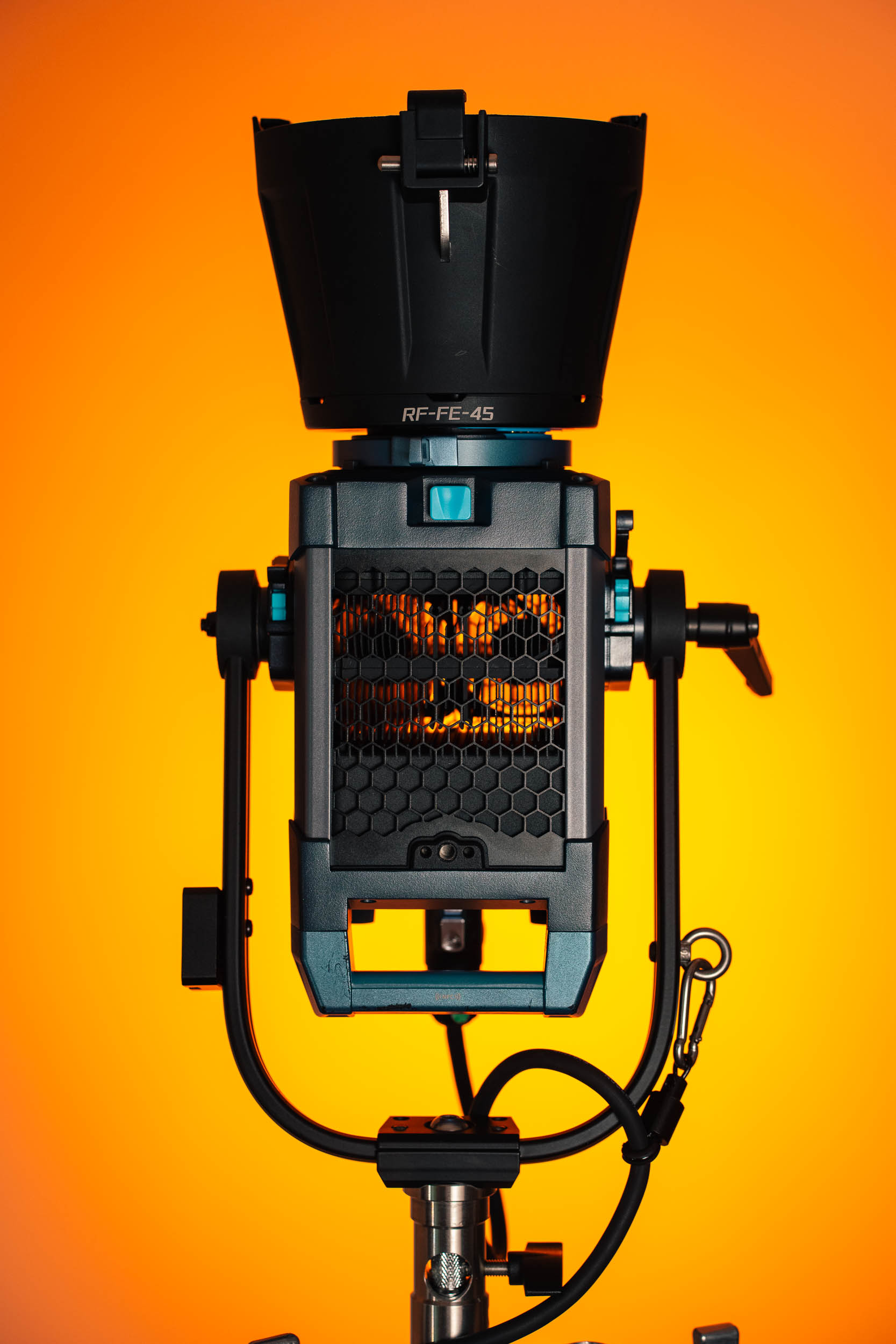
Despite its professional construction, the Evoke 150C remains surprisingly compact for a 150-watt RGB light. Even more important to me, however, is the noise level. The Evoke 150C operates pleasantly quietly. This is particularly important for interviews or film productions because a powerful light is of little use if a clearly audible fan is running right next to the microphone. With the Evoke 150C, I had to worry about that far less.
I particularly like the design around the yoke. The standard yoke can be removed and replaced with a baby pin. This means the light can not only be used like a conventional COB fixture on a normal light stand but can also be mounted much more easily on trusses, grip equipment or in tight areas of a set. For professional productions in particular, this flexibility is far more valuable to me than another effect mode in the menu.
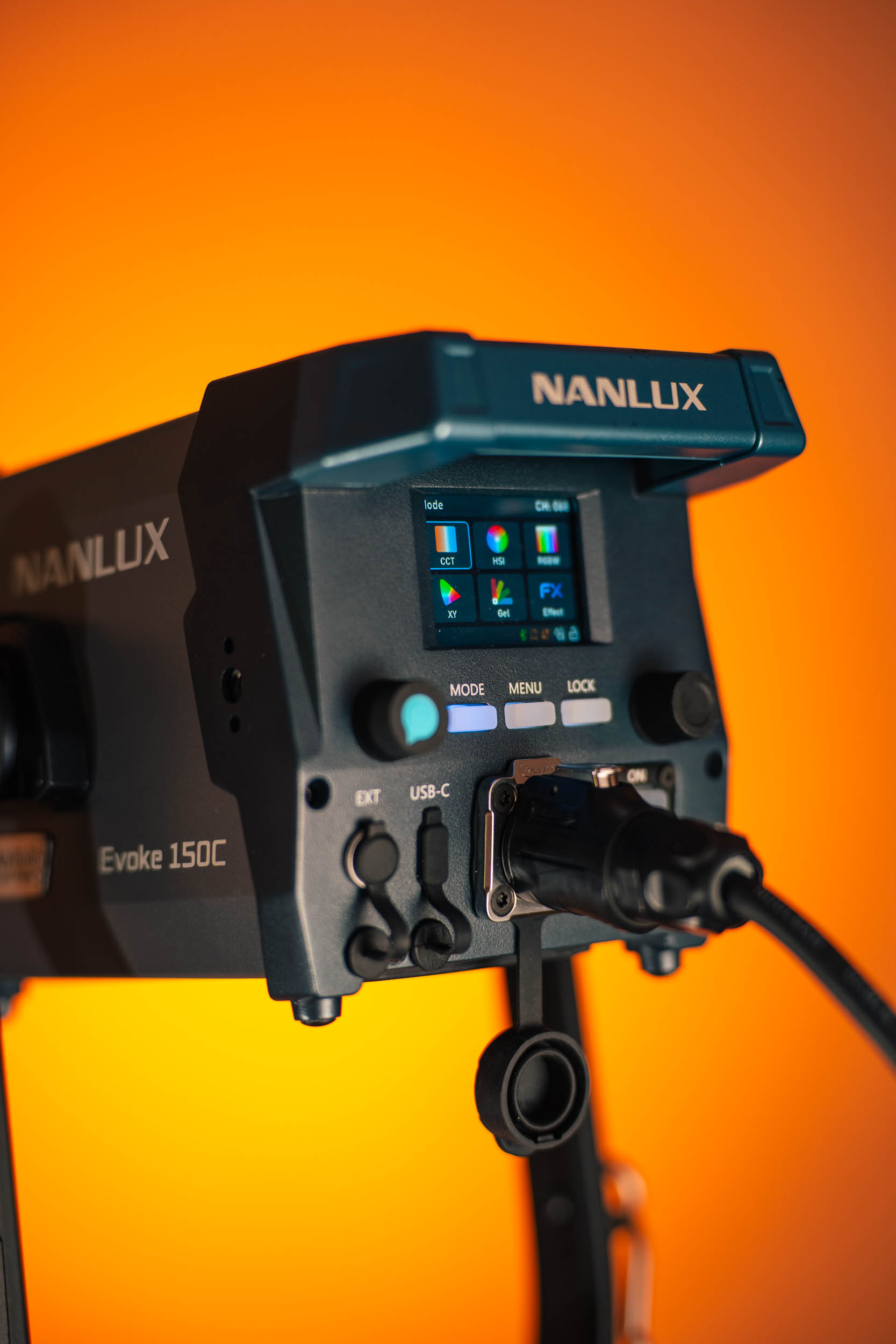
The professional approach is also evident in the control options. In addition to direct control on the fixture, there is DMX, various colour modes and colour spaces as well as numerous built-in effects. As soon as several lights need to be controlled at the same time, DMX is a major advantage for me. You do not have to adjust every individual fixture using its display or a separate app.
If you prefer working with a smartphone, the Evoke 150C can of course also be controlled through the Nanlink app. The app offers basically everything you need in everyday use. You can adjust colours, dim the light, activate effects, switch the fixture on and off or perform firmware updates. This keeps operation straightforward even outside a professional DMX setup.
Light Output and RGB
Of course, the Evoke 150C can produce saturated colours. But quite a few lights can do that nowadays. What is more interesting to me is how usable those colours actually are.
The Evoke 150C makes a very good impression here. The colours look strong and saturated and provide enough output to be used for more than just a small accent in the background. However, not all colours are equally bright. Yellow reached 10'927 lux in the lab test and green 6'342 lux, while red measured 1'364 lux and magenta 1'307 lux. This is not unusual for RGB systems but it should be taken into account when building a lighting setup.
I find the white-light output even more interesting. Although the Evoke 150C covers an extremely wide CCT range, its output remains surprisingly consistent. At 2700 K, I measured 11'645 lux. At 5500 K, the output was 12'951 lux and even at 20'000 K the fixture still produced 11'153 lux.
I much prefer this to lights that achieve an impressive maximum output at their optimum colour temperature but then lose a considerable amount of output towards the edges of their CCT range. In practical terms, this means: Brightness remains quite predictable across the CCT range.
There is one aspect of the accessory system that I like less. The Evoke 150C uses the Nanlux/Nanlite modifier system. If you already own a larger collection of Bowens-S softboxes or other Bowens modifiers, you cannot simply continue using them directly. For me, this is probably the biggest practical disadvantage of the light.
On the other hand, the reflectors designed for the system work very well. Without a reflector, the Evoke 150C reaches 12'951 lux at 5500 K. With the standard reflector, this rises to 21'915 lux and with the tested kit reflector even to 23'746 lux at one metre. The system is therefore certainly efficient. You just have to be aware that it ties you more closely to the Nanlux/Nanlite ecosystem.
My Impressions After Practical Use
After the first productions, one impression stands out above all: The Evoke 150C was not designed to look as spectacular as possible on a specification sheet. It was designed to cause as few problems as possible on a professional set.
The light is robust, quiet and flexible to mount. The power connection locks securely, DMX is available and the Evoke 150C also offers significantly more options in terms of colour modes, colour spaces and effects than a simple white-light COB fixture.
At the same time, the light output remains very consistent across the wide CCT range and the RGB colours are powerful enough to actually work with creatively. As a result, I have surprisingly little to criticise.
The biggest criticism for me remains the accessory system. Anyone already heavily invested in Bowens will have to commit to an additional ecosystem here. Apart from that, the Evoke 150C feels like a very well-rounded light.
And perhaps that is the bigger compliment when it comes to professional equipment. It is not necessarily about one single feature that outperforms everything else but rather about a light that simply works in everyday use and causes as few problems as possible.
Nanlux Evoke 150C – Technical Analysis
🔍 Key Specifications and Measurements
| Parameter | 3200K | 5500K | 6500K |
|---|---|---|---|
| Brightness (Lux) | 12'059 | 12'951 | 11'638 |
| CRI (Ra) | 99.0 | 98.0 | 96.3 |
| R9 (Red Rendering) | 96 | 94 | 80 |
| TM-30 Rf/Rg | 97/100 | 96/101 | 96/102 |
| SSI | 85 | 77 | 71 |
| CCT Deviation (MK-1) | 5.09 | 10.38 | 14.16 |
| DUV (Green Tint) | -0.00170 | -0.00198 | -0.00317 |
The analysis was carried out using a total of 42 measurements at a distance of 1 m.
Data Overview
TM-30-18
TM-30 Multi Report
TM-30 Comparison
Multiple measurements in direct comparison
Report selection by CCT
All loaded reports are sorted by CCT automatically. The slider snaps to the nearest report.
Color Vector Graphic
Reference and test as closed 16-bin curves.
Normalized Spectral Power Distribution
TM-30 Dashboard
Local shifts and radial visualization as in the standard report.
Local Chroma Shift (Rcs,hj)
Local Hue Shift (Rhs,hj)
Local Color Fidelity (Rf,hj)
Color Sample Fidelity (Rf,CESi)
Direct overview of all 99 CES samples with fidelity values.
Measure Comparisons
Additional comparison view analogous to the TM-30 reference representation.
Color Evaluation Samples
Highlighted skin-tone areas provide practical orientation for portrait colors. Click to zoom.
Chart
💡 White Light and Output
One of the greatest technical strengths of the Evoke 150C is the consistency of its white-light output across the entire CCT range. Between 2700 K and 20'000 K, the measured output remains surprisingly close: at 2700 K the light reaches 11'645 lux, at 5500 K 12'951 lux and even at 20'000 K it still delivers 11'153 lux at 1 m.
That is quite remarkable for a full-colour light. Depending on the design, different colour temperatures can lead to noticeable drops in output because the individual LED channels have to be combined at different intensities. With the Evoke 150C, however, the differences remain comparatively small.
In practical terms: When switching between warm tungsten light, daylight and very cool lighting looks, the available amount of light changes only moderately. This makes the fixture relatively predictable on set.
The dimming behaviour is also very predictable. At 5500 K, I measured 1'246 lux at 10%, 6'330 lux at 50% and 12'951 lux at 100%. Brightness therefore follows the selected output level very closely across much of the dimming range. The light uses PWM dimming at frequencies between 17,950 Hz and 20,620 Hz. With an unsuitable shutter speed, this can result in banding or flicker. You should therefore make sure that the shutter speed is chosen appropriately to avoid visible artefacts.

This is particularly interesting for DMX-controlled setups and reproducible lighting configurations. If you program a certain brightness level, for example, you can be reasonably confident that the same setting can be reproduced during a later setup.
The reflector system also makes a good impression. Without a reflector, I measured 12'951 lux at 5500 K, 21'915 lux with the standard reflector and as much as 23'746 lux with the kit reflector.
Of course, the fixture does not suddenly produce more light. The reflector concentrates the available luminous flux onto a smaller area. Nevertheless, the significant increase shows that the optical system works efficiently. The BDR-W55 measures considerably lower at 1'895 lux, although this is not directly comparable because the beauty dish distributes the light over a much wider area.
🎨 Colour Quality and CCT Accuracy
In terms of light quality, the Evoke 150C with its C8 light engine shows an interesting combination of excellent colour rendering and CCT calibration that is not always perfect.
3200 K in particular is a real sweet spot in the measurements. Here, the light achieves CRI Ra 99, R9 96, SSI 85 as well as TM-30 Rf 97 and Rg 100.
The SSI of 85 is particularly interesting. For me, this is one of the highest values I have measured so far from an LED fixture of this type. While a high CRI mainly describes colour rendering, SSI provides additional information about how closely the spectrum matches that of a reference light source. This can make a noticeable difference especially when mixing different light sources.
Colour rendering also remains very good at 5500 K: Ra is 98, R9 is 94, TM-30 Rf is 96 and Rg is 101. SSI, however, drops to 77.
This shows that the Evoke 150C’s good colour rendering is not simply based on a high CRI value. The overall spectrum is very well balanced.
⚠️ Excellent Light Quality, but Increasing CCT Deviation
Two things need to be clearly separated here: The Evoke 150C produces very high-quality white light but it does not reproduce the selected colour temperature with the same degree of accuracy across the entire range.
When assessing CCT accuracy, the deviation in Kelvin is not the only relevant value. Because the Kelvin scale is not linear, Mired or MK-1 values are considerably more meaningful when comparing colour-temperature deviations. They show the actual shift along the colour-temperature axis.
| Target CCT | Measured | Deviation | MK-1 |
|---|---|---|---|
| 2700 K | 2707 K | +7 K | 0.96 |
| 3200 K | 3253 K | +53 K | 5.09 |
| 5500 K | 5833 K | +333 K | 10.38 |
| 6500 K | 7159 K | +659 K | 14.16 |
| 10'000 K | 12'031 K | +2031 K | 16.88 |
| 15'000 K | 20'873 K | +5873 K | 18.76 |
| 20'000 K | 25'185 K | +5185 K | 10.29 |
The MK-1 values make this progression much clearer than the Kelvin difference alone. At 2700 K, the light is practically spot on with a deviation of only 0.96 MK-1. At 3200 K, 5.09 MK-1 is still very respectable. At 5500 K, however, the deviation rises to 10.38 MK-1 and at 6500 K to 14.16 MK-1.
The difference becomes particularly noticeable at the extremely high CCT settings. 10'000 K results in an actual measurement of 12'031 K and a deviation of 16.88 MK-1. At 15'000 K, the fixture measures 20'873 K or 18.76 MK-1. At 20'000 K, the light reaches 25'185 K, although the deviation drops again to 10.29 MK-1.
For me, this means: Up to around 3200 K, the Evoke 150C is very precise in terms of CCT output. From 5500 K onwards, the deviation becomes increasingly relevant and above 6500 K the displayed Kelvin value should no longer be regarded as an exact reference value.
However, this is not a problem with the actual quality of the light. A fixture can produce 5833 K instead of 5500 K and still have an excellent spectrum. That is exactly what we see here: at 5500 K, the Evoke 150C still achieves Ra 98, R9 94, TM-30 Rf 96, Rg 101 and SSI 77.
The CCT calibration is therefore not perfect but the quality of the actual white light produced is still excellent.
It is also interesting that Duv remains comparatively clean. The white-light measurements are mostly slightly negative, meaning that the deviation takes place more along the colour-temperature axis rather than shifting significantly towards green or magenta.
This is an important distinction in practical use. A certain amount of CCT deviation can be compensated for relatively easily. A pronounced green or magenta tint is much more disruptive when mixing different light sources. In addition, the Evoke 150C offers an integrated green/magenta shift, allowing the light colour to be corrected further.
The Kelvin calibration is therefore not perfect across the entire range. However, the actual spectral quality and stability of the white-light source remain largely unaffected.
Red Rendering at High Colour Temperatures
At 6500 K, it is also noticeable that R9 drops to 80, while Ra remains high at 96.3.
This once again shows why professional lighting tests should not rely solely on CRI. R9 describes the rendering of saturated red tones and is relevant, among other things, when evaluating skin tones. The Evoke 150C is certainly not bad at 6500 K but the spectral balance is more convincing at 3200 K and 5500 K.
🌈 RGB and Colour Output
The Evoke 150C also delivers strong but not completely uniform performance when it comes to RGB colours.
At 100%, the following illuminance values were measured for the different colours:
| Colour | Lux @ 1 m |
|---|---|
| Yellow | 10'927 |
| Green | 6'342 |
| Cyan | 3'078 |
| Blue | 2'106 |
| Red | 1'364 |
| Magenta | 1'307 |
However, these figures should not simply be interpreted as a direct indication of how much optical power each LED colour actually produces. Lux is photometrically weighted and therefore values green light much more strongly than deep red or blue light, for example.
Nevertheless, the practical consequence remains the same: Not all RGB colours offer the same exposure headroom. If you want to illuminate a large area in a strong red or magenta, you will need to move the light closer to the subject or use more output than with a yellow or green look.
The colours themselves can be produced with very high saturation. At full output, red achieves a measured purity of 99%, while blue reaches 96.1%.
Not every hue is reproduced perfectly accurately, however. Yellow, for example, measures 50.9° with a target value of 60°, while green measures 135.6° with a target of 120°.
This also partly explains the comparatively low RGB score of 64.1 in the lab test. The fixture can produce very strong colours but it is not perfectly colourimetrically calibrated in every hue.
For typical film, photography and effects lighting, however, I see this as a considerably smaller limitation than in an application where colours need to be reproduced with absolute precision.
📌 Overall Technical Assessment
From a measurement perspective, the Evoke 150C is therefore an interesting combination. It is not a perfectly calibrated reference light source, particularly because of the CCT deviations at higher Kelvin values and the RGB hues that are not always reproduced exactly.
Its strength lies instead in the combination of high output, consistent white-light performance, excellent colour rendering and a powerful full-colour system.
The white-light performance is particularly strong. Brightness remains remarkably consistent across an enormous CCT range while the fixture simultaneously achieves very good CRI, R9, TM-30 and SSI values. At 3200 K, the Evoke 150C is particularly impressive with SSI 85, Ra 99 and R9 96.
The biggest technical limitation is the CCT calibration. Anyone who needs exactly 5500 K or 6500 K should not blindly rely on the value shown on the display. At the same time, the white-light axis remains clean and can be adjusted further using the G/M shift.
The RGB colours are also not equally bright, which is generally to be expected from a full-colour system. However, the colours are strong and provide enough output for typical creative applications.
In short: The Evoke 150C is not optimised to achieve perfect measurements in every individual discipline. Instead, it is designed to combine a lot of light, excellent light quality and maximum flexibility in a single professional fixture. And it is precisely this combination that makes the technical results so interesting in practice.
My Conclusion
For me, the Nanlux Evoke 150C is a good example of why a professional RGB light should not be defined solely by its maximum output.
The 150 watts are impressive. But what I find even more interesting is the combination of output, colour rendering, robustness, noise level, control options and mounting flexibility.
You can tell that the Evoke 150C was designed for professional sets and rental houses. The locking power connection, DMX compatibility, robust construction and different mounting options do not feel like extra features added for the specification sheet but rather like features that were developed around a real production workflow.
There is also a lot to like from a measurement perspective. White-light output remains remarkably consistent across the CCT range and at 3200 K the spectral quality is particularly strong with an SSI of 85.
The light is not perfect, however.
The selected colour temperatures are sometimes missed by a considerable margin, particularly at the higher end of the CCT range and there are large differences in output between the individual RGB colours. The proprietary modifier system is another disadvantage, particularly for users who already own a substantial Bowens setup. Even so, there is surprisingly little to criticise overall. The Evoke 150C is not simply another 150-watt RGB light. It is a professional working light where you can tell that reliability, integration and flexibility were more important than achieving one spectacular specification-sheet number. And that is exactly why I can easily imagine it becoming one of those lights on set that you no longer want to work without.
Related Articles


Diclaimer
This product was provided free of charge by Dedotec. However, this has no influence on my opinion or the evaluation of the product. I tested the light independently and shared my honest opinion. The product went back to the provider after the test.

Nanlux Evoke 150C

Nanlux Evoke 150C
Produktfeatures
- Lichtstarke LED RGB-Color Spotleuchte 150 W
- Netzbetrieb oder Akkubetrieb möglich
Copyright © of product image in the title image are the ones of the respective manufacturers. All rights reserved.


